

Calgary's Employment Paradox: Job Gains Mask Full-Time Losses Amidst Economic Headwinds
We’re hearing that Calgary's employment rates are showing some interesting trends. This annual report dives into the numbers and what they mean for our city's economic future.
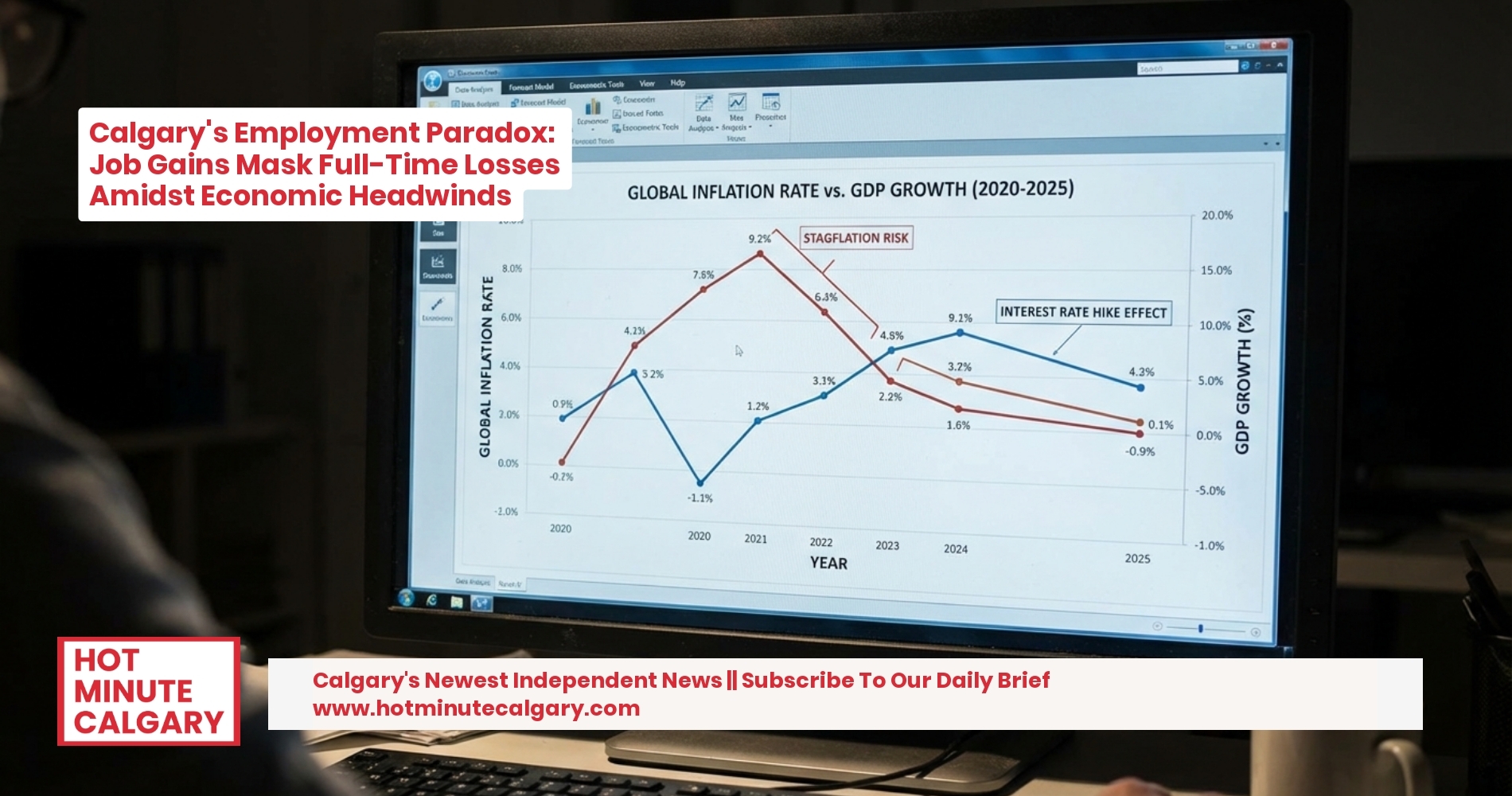
Calgary's economic landscape continues to present a complex picture for its residents and policymakers. As of November 2025, the city's unemployment rate stood at 7.3%, based on seasonally adjusted three-month moving averages. While the Stampede City saw a net increase of 5,900 total jobs that month, a closer look reveals a concerning trend: 7,600 new part-time positions were added, even as 1,700 full-time roles vanished from the market. This dynamic signals a potential shift in the quality of available work, something keenly felt by those navigating the competitive job hunt here along the Bow River.
This nuanced growth comes as the Calgary Economic Region (CER) grapples with a labour market that is expanding faster than its capacity to create full-time employment. In March 2025, the CER's three-month moving average unemployment rate hit 7.7%, a notable climb from 7.0% just a year prior. While the labour force itself swelled by 5.2% year-over-year that month, employment lagged, growing at a slower 4.3%. For a city experiencing significant population influx, this disparity translates directly into more people seeking fewer suitable opportunities. The city's unemployment rate reached 7.9% in November 2024, already higher than the national rate of 6.8%, largely because the sheer volume of new Calgarians outpaces the creation of new jobs.
The Struggle for Stability on the Home Front
Beyond the statistics, the concrete impact on everyday Calgarians is palpable. Advocates express growing concern over the widening poverty gap, noting that basic necessities here reportedly cost more than in any other major Canadian city, according to the Market Basket Measure. This makes finding stable, well-paying employment not just a preference, but an urgent necessity for many families trying to make ends meet in our bustling metropolis. Meanwhile, Alberta's labour force participation rate in November 2025 saw a slight uptick to 69.1%, an increase of 0.1 percentage points from the previous year, suggesting more people are entering the job market, adding further pressure to an already strained system.
Government Initiatives and Industry Concerns
In response, the Government of Alberta, through its Ministry of Jobs, Economy and Trade's 2024-27 Business Plan, has outlined initiatives aimed at enhancing the province's competitive edge. With an allocation of $101.4 million for skills and training programs in 2024-25, the province hopes to deliver policies that will attract a highly skilled workforce and promote healthy workplaces, contributing to a broader economic prosperity that stretches from the foothills down Deerfoot. The national picture also offers a comparative benchmark, with Canada's unemployment rate holding steady at 6.9% in July 2025.
However, not everyone is convinced the current approach fully addresses the underlying issues. The Calgary Chamber of Commerce has voiced significant concerns about a persistent misalignment within the labour market. Ruhee Ismail-Teja, Vice President, Policy & External Affairs, noted in April 2025 that there are "clear signs of misalignment between workforce development and market demand." She highlighted that over 28% of Canadian businesses struggle to find skilled workers, underscoring a growing chasm between the skills job seekers possess and what employers actually require. This is further evidenced by the Calgary Economic Region's seasonally adjusted job vacancy rate, which dropped to 2.9% for the fourth quarter of 2024—the first time it fell below 3% since the first quarter of 2021—suggesting fewer open positions for those seeking work.
As Calgary continues its rapid growth, the challenge for city and provincial leaders remains clear: how to not only create more jobs, but to foster an environment where those jobs are full-time, stable, and align with the skills of a diverse and expanding workforce. It’s a delicate balancing act, one that will define the economic health of our city for years to come.
Comments ()